A village newsletter landed on my desk recently, and the headline was bold enough to make anyone reach for their softener bypass valve: “YOU MUST TURN OFF YOUR WATER SOFTENER!” The reasoning offered was that the municipal plant is now blending toward a target of 75 to 85 % softened water, and that residents should not exceed 90 % softened because doing so “can be harmful to your pipes.”
I understand the instinct behind that warning…somebody, somewhere, told a well-meaning public-works employee or elected official that “over-softening” causes plumbing damage, and it got repeated until it somehow became official guidance.
Thanks for reading! Subscribe for free to receive new posts and support my work.
It is not the first time this has happened, and it will certainly not be the last. The “over-softening” claim doesn’t hold up though, and it is worth walking through, because this misconception costs homeowners money and costs our industry credibility every time it goes unaddressed.
There is no such thing as “over-softening”
Softening is a binary condition. Water is either soft, meaning the hardness ions (calcium and magnesium) have been reduced to below one grain per gallon (17.1 mg/L as CaCO3), or it is not soft. A municipal plant that blends fully softened water with untreated water to land at a residual hardness of, say, 3 to 5 grains per gallon has not created “90% soft water.” It has created moderately hard water with a lower hardness value than before blending. The percentage figure some utilities use is a blending ratio, not a measurement of how “soft” the water has become. There is no point on that scale where water crosses into some more aggressive state simply because more of the blend came from the softened side of the plant.
If a home softener downstream of that blend is properly sized and programmed for the actual influent hardness, it will do exactly what it is designed to do: exchange the remaining calcium and magnesium, and produce water at or near zero hardness. Nothing more, nothing less.
What ion exchange does, and does not, remove
A cation exchange softener exchanges calcium and magnesium ions for sodium or potassium ions. It does not touch the carbonate and bicarbonate alkalinity in the water. Those valuable buffering compounds stay in the water. Total dissolved solids remain essentially unchanged (in my experience, conductivity usually rises by ~10%), and the pH does not shift in any meaningful way.
This is important to understand, because the corrosivity concerns people are reaching for (usually some version of the Langelier Saturation Index) depend heavily on alkalinity and pH, not just on hardness alone. Ion exchange softened water retains its natural buffering capacity, making it fundamentally different from naturally soft water, which typically arrives with low alkalinity and low TDS to begin with, and is genuinely more aggressive because it lacks a buffer. It is also dramatically different from reverse osmosis purified or deionized water, which strips out both hardness and alkalinity and can behave “hungry” for minerals, actively seeking to dissolve them from whatever surface it touches. Ion exchange softening is neither of those things. Confusing the two is the root of nearly every “over-softening” scare I have encountered in more than 30 years in this business.
There has been a lot of research undertaken into this issue:
- A 1998 EPA pilot loop study comparing ion exchange softened water against non-softened water at two different pH and hardness levels found no evidence that softening systematically increased metal leaching from household plumbing.
- A parallel study commissioned by the British Standards Institute for the UK Water Treatment Association ran identical central heating rigs on hard and ion exchange softened water and found no significant difference in corrosion rates for copper, brass, mild steel, or stainless steel.
- A separate long-term field study out of the METALogic research institute in Belgium reached similar conclusions on copper and galvanized steel systems.
This is all rigorous, peer-reviewed work that the Water Quality Association has reviewed directly. WQA’s own white paper on cation exchange softened water and corrosion, first adopted by the Board of Governors in 1978 and most recently reaffirmed in 2020, walks through the same body of research, and lands on the same simple conclusion: a properly configured water softener does not make treated water more corrosive. That is not marketing-speak, it is the considered technical position of the association charged with setting technical and ethical standards for the industry.
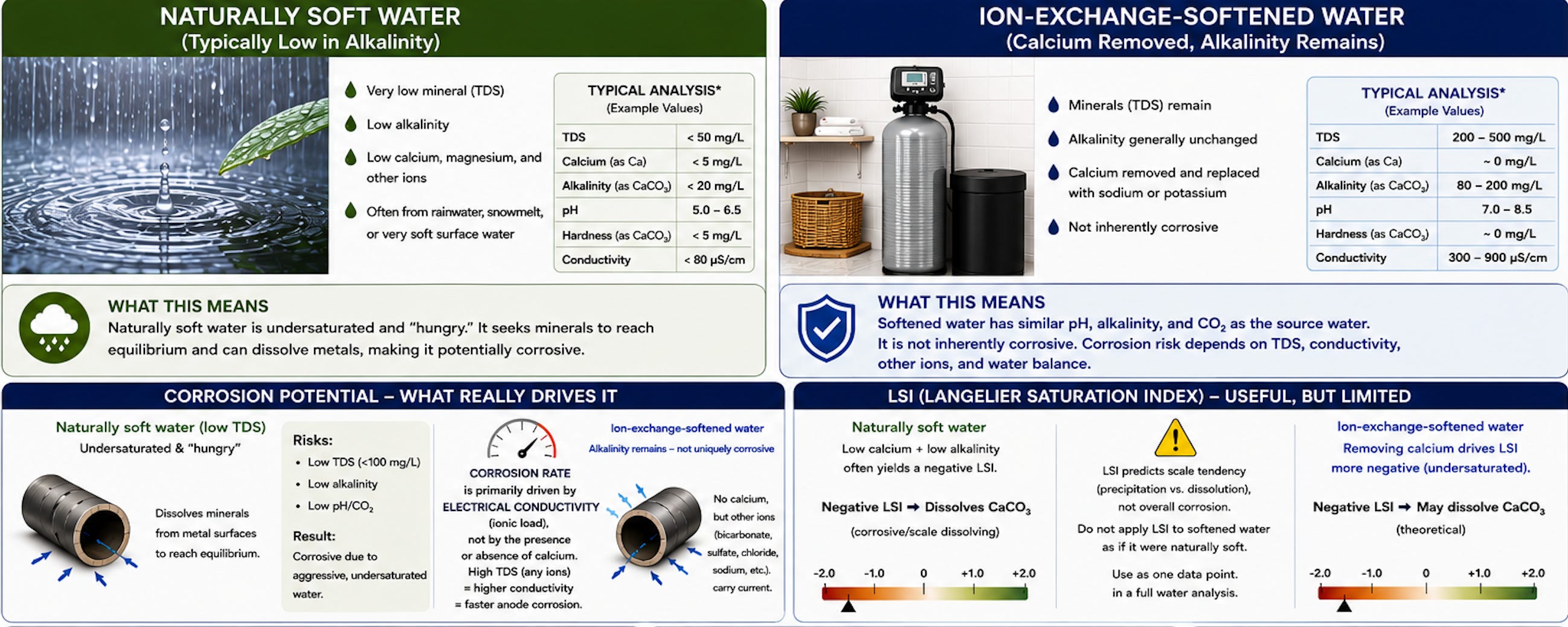
Where the real risks actually live
I am not going to pretend that plumbing damage never happens near a softener. It does, but the causes are inevitably something other than the hardness reduction itself:
- Elevated water temperature above 140 degrees Fahrenheit (60°C) accelerates corrosion regardless of hardness.
- High flow velocity and turbulence cause erosion corrosion.
- Sudden pressure changes cause cavitation corrosion.
- Stray electrical current from a grounding strap that has come loose from metal plumbing causes measurable pitting.
- Dissimilar metals in direct contact or through an electrolyte (water) will cause galvanic corrosion.
- A poorly programmed softener might not rinse out regenerant byproducts at the end of a regeneration cycle that raises water conductivity to cause galvanic corrosion.
The instinct to protect is reasonable, but targeting the softener is not.
The fix is certified products and certified people
None of this is ever a reason for a municipality to tell every resident to shut off their water softening equipment. Water softeners are beneficial home appliances, and when properly configured and maintained will provide significant benefits to any home.
- Soft water reduces the amount of soap and detergent needed to get laundry and dishes clean, and it does so without leaving mineral spots on glassware or scale film on dishes.
- It cuts the energy required to heat water, since scale buildup inside a water heater acts as an insulating layer that forces the appliance to work harder for the same result.
- It extends the working life of water heaters, dishwashers, washing machines, ice makers, and steam irons, all of which fail earlier when hardness minerals are left to accumulate on heating elements and moving parts.
- It protects faucets and fixtures from the scale that eventually clogs aerators and cartridge valves.
- It also reduces the conditions that allow biofilm to establish itself in a washing machine, since a scaled surface gives bacteria more places to take hold than a clean one.
Add up the reduced detergent use, the lower water heating bill, and the extended appliance life, and a properly sized softener can pay for itself many times over during its service life. None of that changes when a municipality “partially softens” its water upstream. It just means the home softener has less work to do, and less salt and water to use, to deliver the same benefits.
Any change at the city level, (including changing their blending ratio of hard and soft waters) is a good reason to talk to your local WQA Certified Water Professional. Get a water test, understand the actual residual hardness coming out of the tap, and then adjust the softener to match it. Why? To prevent the softener from regenerating more often than the water actually requires, wasting salt and water in the process.
If you are a homeowner reading a similar notice from your own utility, get your water tested and have a certified professional set it correctly for the water you actually have today.
If you are on the utility side writing the next newsletter, please consult with the Water Quality Association before you publish. We would rather help you get it right than watch the same myth make another round.
What a great time to be in the water business!
Further reading
Sorg, T., Schock, M., and Lytle, D. (1998). “Leaching of Metals from Household Plumbing Materials: Impact of Home Water Softeners.” U.S. Environmental Protection Agency.
Munn, P. (2012). “Results from testing corrosivity of hard and softened water in model central heating systems at BSI, Loughborough.” Midland Corrosion Services Ltd.
Verdonckt, C., and Nijs, C. (2007). “In situ corrosion investigation on the effect of hard and softened water to domestic copper and galvanized steel drinking water systems.” METALogic, Leuven, Belgium.
Water Quality Association. (2006). WQA Response to Nashville Metro Water Services Softened Water Communication. WQA Industry Update.
Reyneke, G. (2016). Soft Water Not for Drinking? Is Softened Water Corrosive?
Water Quality Association. (2023). WQA White Paper on Cation Exchange Softened Water and Corrosion. Adopted 1978, reaffirmed 2020, last reviewed by Technical Affairs February 8, 2023. https://wqa.org/wp-content/uploads/2023/05/2023_WaterSoftenersAndCorrosion.pdf
Harrison, J. F., & Nowlin, D. (n.d.). Corrosion and Soft Water. Excerpted from WQA’s Corrosion QuickCourse, WQA Educational Kit, Section IV, Issue V. https://wqa.org/wp-content/uploads/2022/09/article-4-Corosion-and-Soft-water-Vol-V.pdf
Raghupathi, P. K., Zupančič, J., Brejnrod, A. D., Jacquiod, S., Houf, K., Burmølle, M., Gunde-Cimerman, N., & Sørensen, S. J. (2018). Microbial diversity and putative opportunistic pathogens in dishwasher biofilm communities. Applied and Environmental Microbiology, 84(5), e02755-17. https://doi.org/10.1128/AEM.02755-17 (PMC5812945)