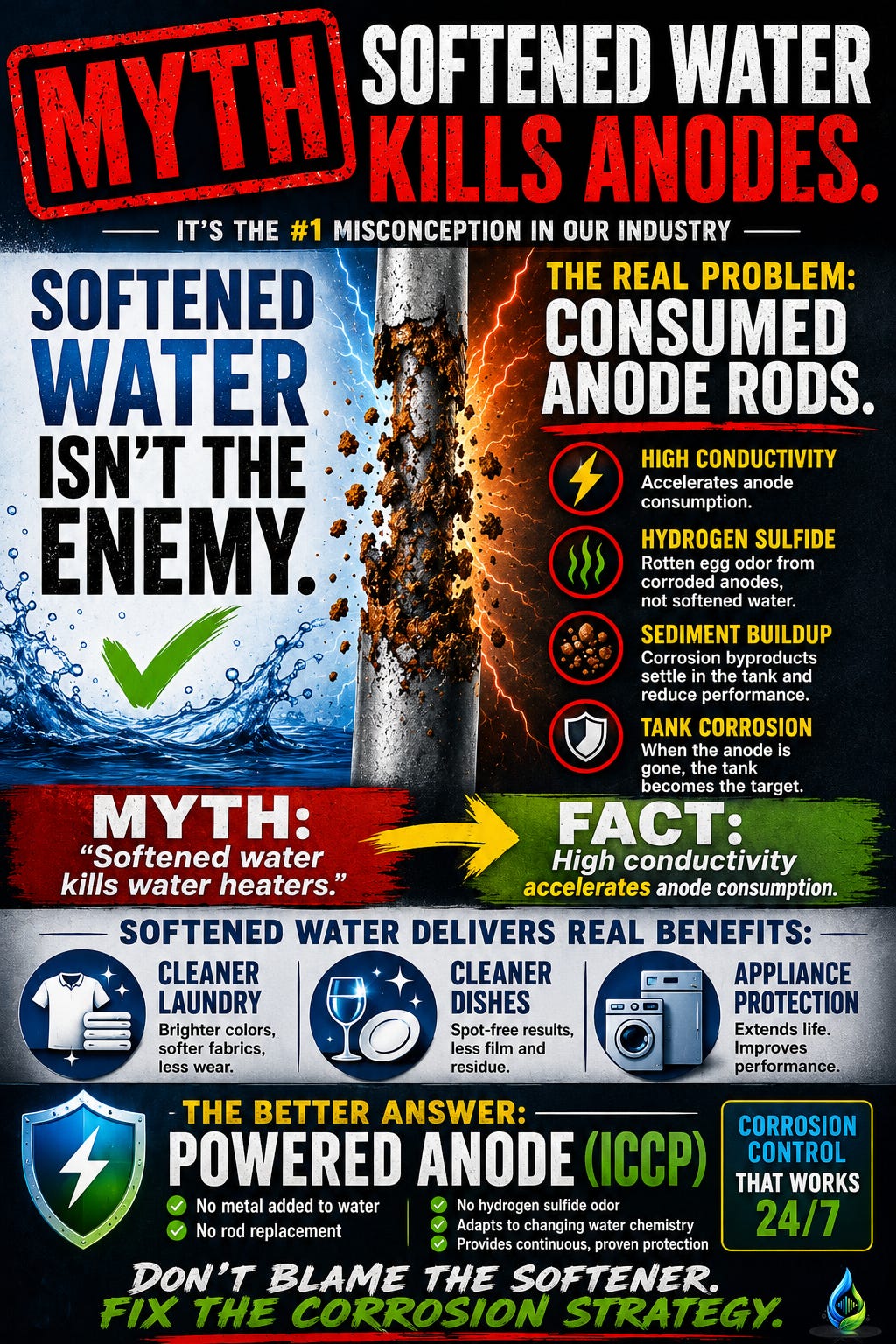
Walk into almost any plumbing supply house in the country and you will hear some version of this: “soft water kills water heaters”. It gets repeated at kitchen tables, in online forums, and occasionally even in the trade press. The problem is that it is a significant oversimplification of a real electrochemical phenomenon, and oversimplifications lead to bad treatment decisions. Silly phrases like “You’re over-softening the water” get used, but they are also not fact-based.
The most common driver of accelerated anode consumption is elevated electrical conductivity in the water, not the mere presence of sodium ions (or the absence of Calcium).
I have been solving corrosion problems for three decades, from residential systems in Utah to mission-critical industrial and institutional systems on multiple continents. The corrosion-mechanism is not mysterious once you understand what is happening at the electrode interface inside your water heater. Once understood, the path to a permanent, low-maintenance solution becomes rather obvious.
How a sacrificial anode works
Modern steel water heater tanks are lined with a glass (porcelain enamel) coating, but microscopic defects, weld seams, and fitting penetrations inevitably expose bare steel to the water column. In the presence of water carrying dissolved ions (electrolytes), those exposed steel surfaces form galvanic cells: anodic sites where metal oxidizes and releases electrons, and cathodic sites where those electrons are consumed in reduction reactions. Without intervention, the tank will eventually corrode from the inside…this is natural and normal.
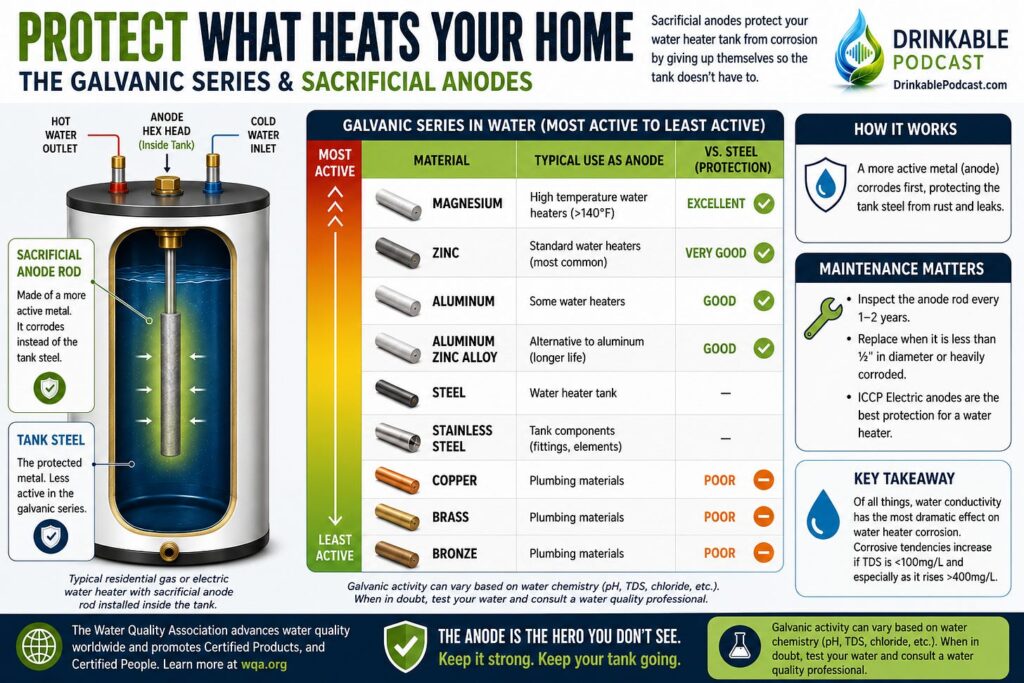
A sacrificial anode rod addresses this by using a metal that sits higher in the galvanic series than steel: magnesium, aluminum, or an aluminum-zinc alloy. The anode material is electrochemically more active, so it oxidizes first (preferentially), releasing electrons that suppress corrosion at the steel surfaces. The rod sacrifices itself so the tank does not have to. The rate at which that sacrifice occurs depends on three primary variables: temperature, the electrochemical potential difference between the anode and the tank steel, and the electrical conductivity of the water acting as the electrolyte. That last variable is the one most relevant to the softener conversation.
What ion exchange does to your water chemistry
Ion exchange softening is a substitution reaction. The cation resin preferentially strips divalent calcium (Ca²⁺) and magnesium (Mg²⁺) ions from the water and releases sodium (Na⁺) ions in their place. Every divalent hardness ion removed is replaced by two monovalent sodium ions to maintain electrical neutrality. That increased ion count drives measurable changes in water conductivity after softening.
A cation exchanger targets only positively charged ions and has no affinity for anions, so anions like carbonate, chloride and sulfate that are present in the source water pass through the softener unreacted. Those anions remain in the softened water at essentially the same concentrations as in the feed water. Softening does not add chloride or any other anion to the product water.
Physical total dissolved solids (measurable with a dry-down test), do not change dramatically and the mass balance is roughly equivalent because two sodium ions weigh roughly the same as one calcium or magnesium ion at comparable concentration.
The conductivity increase after softening is real…in my experience, the post-softening conductivity increase averages around 10%, though that figure can vary considerably with source water composition and should not be treated as a universal constant.
Proper softener programming and adequate rinse cycles are also critical. Older systems or poorly programmed units that allow regeneration byproducts to carry through will produce brief conductivity spikes that field technicians have historically blamed on softeners as a category, rather than on the specific operational failure causing the slug of salty regeneration byproduct that can have TDS levels >10,000 mg/L. This is very important to explore and diagnose properly.
Bradford White’s published technical guidance on anode rod selection confirms the conductivity framing: “…in conditions where water is more conductive, including softened water, the sacrificial process in magnesium anode rods is accelerated, and aluminum rods become the preferred material choice for those applications”.
Their guidance goes further, suggesting that installers target 10 to 12 grains per gallon of residual hardness rather than treating to zero, on the basis that lower conductivity will extend sacrificial anode life. I disagree with this assertion. It is a simplistic view, since residual hardness does not completely protect against corrosion, especially when the natural conductivity of the water is elevated.
As this article documents in detail, scale is non-uniform, and the LSI is an unreliable corrosion predictor in softened water. The WQA’s technical position is that hardness neither causes nor prevents tank corrosion. Bradford White’s 10-12 gpg target reflects a warranty-protection posture for its sacrificial anode products, not a scientifically defensible corrosion management strategy. Under-softening the water to coax another year out of a rod is engineering around the wrong challenge.
Any source of elevated conductivity has an impact
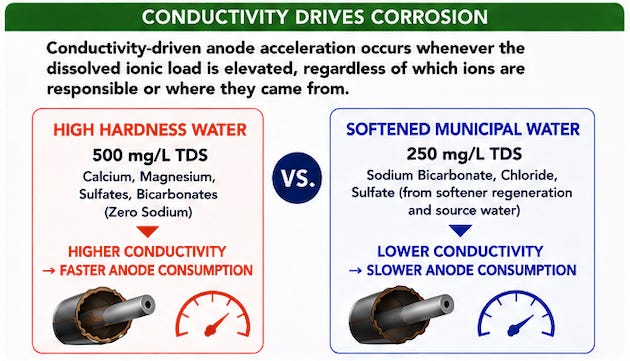
Ion exchange Softened water is not uniquely aggressive. Conductivity-driven anode acceleration occurs whenever the dissolved ionic load is elevated, regardless of which ions are responsible or where they came from. A raw water source carrying 500 mg/L of TDS in calcium, magnesium, sulfates, and bicarbonates with zero sodium will consume an anode faster than ion exchange softened municipal water with 250 mg/L of TDS.
The WQA Corrosion Educational Kit, authored by Joseph F. Harrison, PE, CWS-VI, and Duane Nowlin, PhD, identifies high mineral concentration as a primary corrosion accelerator because it increases electrical conductivity and therefore the current flow in electrolytic cells. That same document states the conclusion directly: ion exchange softening neither causes nor controls corrosion.
The reasoning follows directly from the mechanism itself. Ion Exchange Softening does not change pH, dissolved carbon dioxide, dissolved oxygen, or total mineral concentration. Those are the actual corrosion drivers. Ion exchange changes which cations are in solution; it does not alter the other factors that govern corrosion rate. This is WQA’s official technical position, written by credentialed professionals, and it aligns precisely with the conductivity-based analysis here.
The Langelier Saturation Index (LSI) provides a useful but limited professional tool. The LSI calculates whether a given water is likely to precipitate calcium carbonate (scale-forming, positive LSI) or dissolve it (corrosive, negative LSI), using pH, temperature, TDS, alkalinity, and calcium hardness as inputs. Softened water, with calcium hardness removed, shifts the LSI in the negative direction: the water becomes undersaturated with calcium carbonate and therefore (according to Langlier) potentially more prone to dissolving carbonate scale.
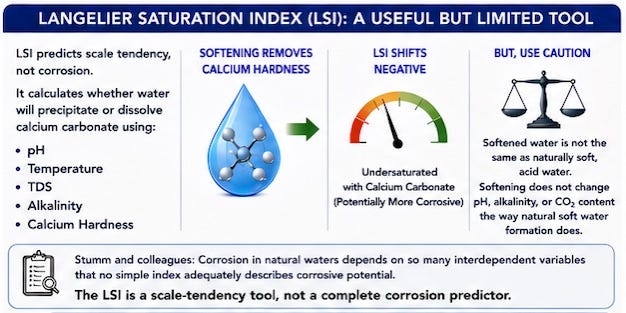
The WQA Corrosion Educational Kit cautions, however, that the LSI should not be applied directly to ion-exchange-softened water as though it were equivalent to naturally-soft acidic water, because the two are chemically different. Softening does not change pH, alkalinity, or CO₂ content to resemble natural soft waters. Stumm and colleagues, cited in that same WQA document, put the broader limitation plainly: corrosion in natural waters depends on so many interdependent variables that no simple index adequately describes corrosive potential. The LSI is a scale-tendency tool, not a complete corrosion predictor. Use it as one data point among several, which is exactly why a full water analysis by a qualified professional is the non-negotiable first step in any corrosion management decision.
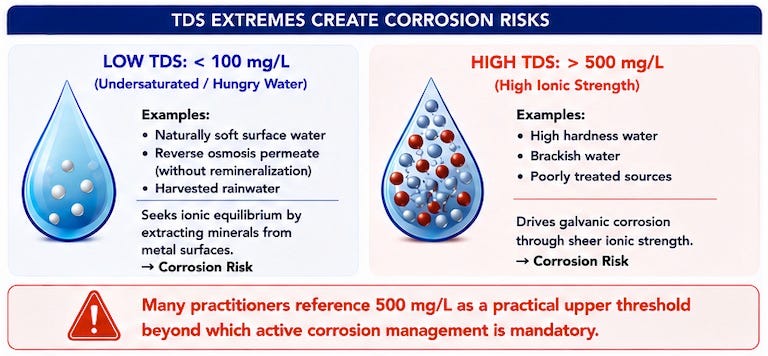
Low TDS water below 100 mg/L presents a different but equally valid problem. Naturally soft surface water, RO permeate without remineralization, or harvested rainwater is undersaturated and behaves as a hungry solvent: it seeks ionic equilibrium by extracting minerals from whatever metal surfaces it contacts. High TDS water above 500 mg/L, conversely, drives galvanic corrosion through sheer ionic strength. Many practitioners reference 500 mg/L as a practical upper threshold beyond which active corrosion management is mandatory.
The WQRF-commissioned Battelle Memorial Institute study (2009) found that gas storage tank water heaters operated on softened water maintained original factory efficiency ratings across the equivalent of a 15-year simulated service life. Hard water at 26 grains per gallon caused measurable scale accumulation on interior surfaces within 30 days of accelerated testing. Units running on 30 gpg hard water at 100 gallons per day usage suffered efficiency losses approaching 48 percent over their service life, with every 5 gpg of hardness driving an 8 percent efficiency penalty at that usage rate. The efficiency story strongly favors softening.
For those tempted to argue that hard water scale provides its own corrosion protection: the WQA Corrosion Educational Kit addresses this too. Scale formation is not uniform. It is heaviest at heat transfer surfaces and low points, with the upper portion of a water heater tank often showing little or no scale at all. Thousands of water heaters fail annually in hard water areas from corrosion occurring under, through, or in locations where protective scale never formed. Hard water scale is simply not a reliable corrosion management strategy; it is an unreliable and uncontrolled byproduct of water chemistry that happens to slow corrosion in some places while accelerating it in others through differential aeration cells.
The problem with metallic anodes
Sacrificial anode rods are the only corrosion protection mechanism most residential water heaters ship with, and they have been a workable solution for decades in the water chemistry conditions for which they were designed. The problem is that those design conditions describe a narrowing slice of the actual installed base. High-TDS water, chloraminated municipal supplies, and elevated-pH source water each push metallic anode systems further toward failure. The symptoms are real, they are showing up in the field every day, and every one of them is diagnosable and preventable with the right knowledge.
Magnesium anodes: rapid depletion and “over-protection”
Magnesium is the most electrochemically active of the three common anode materials, sitting well above both aluminum and steel in the galvanic series. That reactivity is precisely its value in standard residential water: it provides strong, reliable cathodic protection across a wide range of conditions. In an elevated-conductivity environment, that same reactivity becomes a liability. The increased conductivity lowers circuit resistance, which drives proportionally higher galvanic current from the anode. The magnesium sacrifices faster, sometimes dramatically so.
In “normal-conductivity” water (100 – 300 mg/L TDS), a magnesium anode rod should last five years or more. In high-conductivity water, field reports document complete depletion in as little as six months (higher conductivity = shorter anode lifespan). Once the magnesium material is consumed down to the steel core wire, protection stops entirely and tank corrosion begins. Most homeowners never know this has happened because the tank provides no visible indication of anode status, and inspection requires physically removing the rod.
Beyond simple depletion, magnesium over-protection in high-conductivity water produces a unique symptom: When galvanic current runs too high, electrolysis at the water-metal interface generates excess hydrogen gas. That hydrogen has to go somewhere…customers usually report milky or cloudy hot water that takes a minute or more to clear after opening the tap. They describe spurting or inconsistent flow from hot-side fixtures. In the presence of sulfate in the source water or sulfate-reducing bacteria colonizing the lower tank, the excess hydrogen combines with sulfate to produce hydrogen sulfide, the unmistakable rotten egg odor that always tracks the hot side and disappears or diminishes on the cold side. Bradford White’s published guidance (Service Bulletin 109) addresses this failure pattern directly, noting that the magnesium anode generates enough hydrogen to create an odor problem when it reacts with sulfur and bacteria, and recommending replacement with an aluminum-alloy rod to minimize the reaction.
A subtler but equally serious consequence of magnesium anode “over-protection” in highly conductive water is damage to the tank lining. The porcelain enamel interior coating of a steel water heater tank is not inert under extreme cathodic current. When current density at the cathode surface exceeds the design range, hydrogen gas evolution can occur directly at the glass-steel interface, causing blistering, micro-fracture, or even spalling of the lining. Once the lining is compromised at multiple sites, the tank is vulnerable to accelerated through-wall corrosion regardless of whether the anode rod is replaced.
Aluminum anodes: slower depletion, more complicated byproducts
Aluminum rods are often positioned as the sensible compromise for high-conductivity water. They are less reactive than magnesium, which means they deplete more slowly in conductive environments and are less prone to the over-protection failures described above. Major manufacturers including Bradford White recommend this material transition when water conductivity is elevated. That specific guidance is correct in its narrowest sense: aluminum does corrode more slowly than magnesium in high-conductivity water. The problem is that switching rod materials does not address why the original anode was failing. It is a product substitution inside a fundamentally flawed protection strategy. An additional complicating factor is what aluminum puts into the water column while it corrodes.
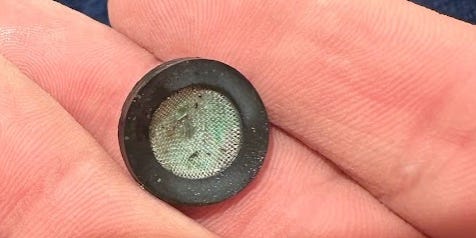
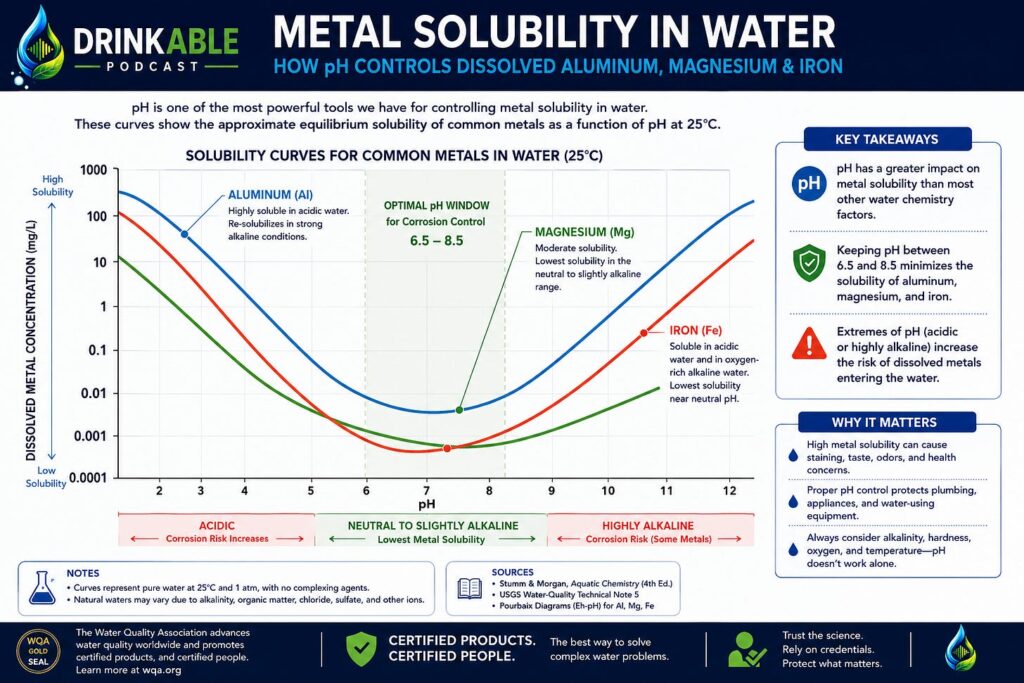
Aluminum oxidizes to form aluminum ions (Al³⁺) in solution. In water with pH below approximately 6.5 or above approximately 8.5, aluminum solubility increases sharply and the rod can release aluminum at elevated rates. A.O. Smith’s Technical Bulletin 14 identifies a specific failure mode in areas of the country where source water pH exceeds 8: aluminum anodes react with the high-pH water to form excessive amounts of aluminum hydroxide (Al(OH)₃) on the anode surface and in the bottom of the tank. Aluminum hydroxide in solution appears as a clear to gray-green gel or as jelly-like beads at drain valves and faucet aerators. It is sticky, coats filter media, clogs aerator screens, and in sufficient quantity produces visibly cloudy or turbid hot water. A.O. Smith’s guidance recommends switching to a magnesium anode and flushing the tank to clear the accumulation.
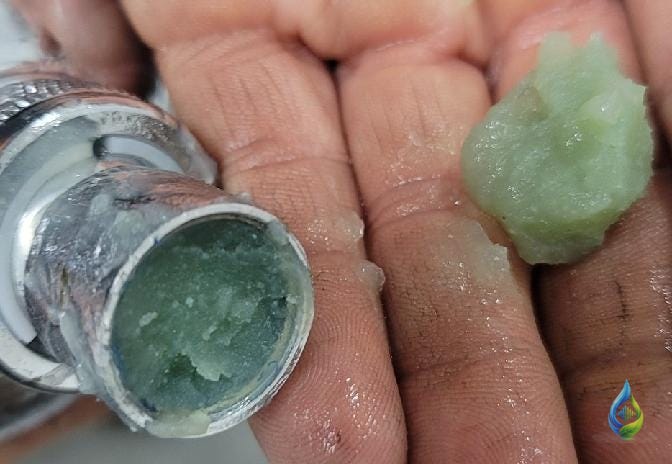
The sediment picture with aluminum anodes extends beyond aluminum hydroxide specifically. As the rod corrodes, oxidized aluminum compounds settle to the tank bottom, joining scale fragments, mineral precipitates, and biological matter in a sediment layer that insulates the heat exchanger surface, increases energy consumption, and creates a protected microenvironment for bacteria. Faucet aerators and showerhead screens clog with white or gray grit. Water filter cartridges may show premature fouling with a white, sandy material. None of these symptoms by themselves tell the homeowner the anode rod is the source; a water treatment professional who asks the right questions during a service call will inevitably recognize the pattern.
The health dimension of aluminum anode corrosion: The U.S. EPA classifies aluminum as a secondary contaminant with a Secondary Maximum Contaminant Level (SMCL) of 0.05 to 0.2 mg/L, framed primarily as an aesthetic threshold for color and turbidity. WHO sets a health-based guideline of 0.2 mg/L. The peer-reviewed literature has found associations between elevated aluminum in drinking water and cognitive decline, though the causal question remains scientifically contested.
The microbial dimension: The conversation about metallic anode rods almost always focuses on chemistry and corrosion, but it should also address microbiology. A 2023 controlled pilot-scale study from Virginia Tech’s engineering faculty examined the effects of anode type, copper dose, and orthophosphate on hot water plumbing microbiomes using shotgun metagenomic sequencing.
The study found that aluminum anodes were associated with enrichment of Mycobacterium avium in bulk water compared to both magnesium anodes and powered titanium anodes. Mycobacterium avium is an opportunistic pathogen of real clinical concern, particularly for immunocompromised individuals, and it is well adapted to hot water plumbing environments. The powered anode performed better in this comparison. While the study was not designed to isolate anode material as the single causal variable for pathogen enrichment, the direction of the finding is consistent with what we already know about how metallic anode corrosion byproducts alter plumbing microbiome composition. The sediment and metal ion environment created by a corroding aluminum rod provides a different microbial habitat than a non-corroding powered anode.
What depleted anode rods look like in the field
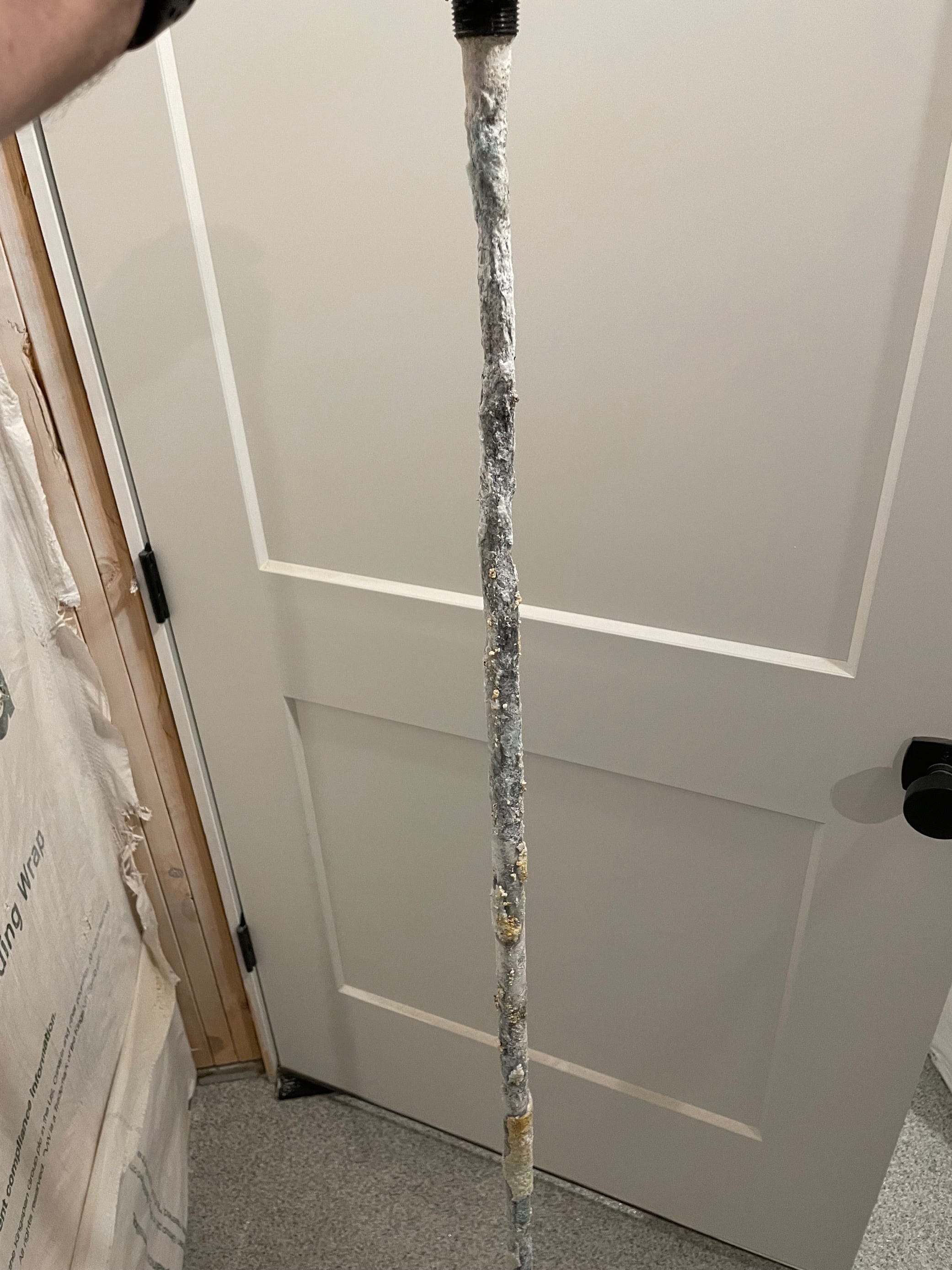
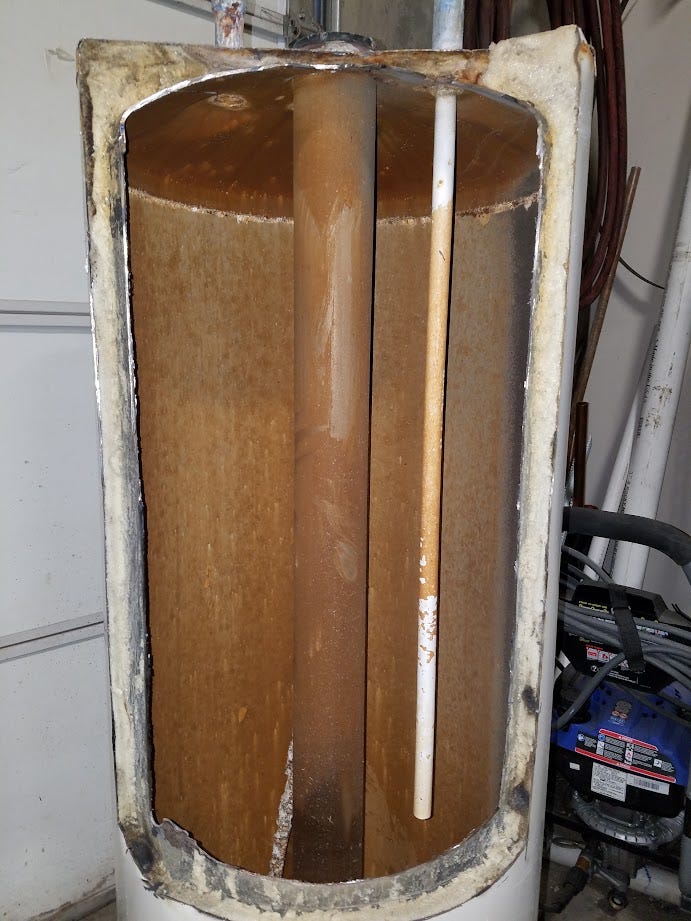
Manufacturers publish inspection criteria, but most homeowners never see them. The universal standard for replacement is when the rod has been consumed to the point where more than six inches of the steel core wire is exposed at either end, or when total cross-sectional diameter has diminished to less than half the original. In practice, the most reliable inspection interval is annual for high-conductivity installations (> 500 mg/L TDS). Lower-conductivity installations may support a two- to three-year interval, but only if the initial water analysis confirmed that chemistry.
The symptoms that should prompt an unscheduled inspection are:
- hot-side milky or cloudy water that takes more than 30 seconds to clear
- rotten egg odor on the hot side only
- grit or white sediment at faucet aerators or filter screens
- noise from the tank during heating cycles (rumbling or crackling from sediment accumulation)
- rust-colored hot water
- reduced hot water volume or temperature, which can indicate sediment insulating the heat exchanger.
Any of these symptoms should be investigated as a probable anode failure until proven otherwise. The rod needs to be replaced, and the tank needs to be inspected, flushed, and disinfected.
Scope: tank-type heaters
Everything in this article applies to conventional tank-type water heaters, which use sacrificial anode rods as their primary corrosion protection mechanism. Tankless and indirect water heaters typically do not incorporate anode rods and have a separate corrosion and water quality management conversation. The Battelle study noted that tankless heaters on hard water failed from scale plugging in downstream piping after just 1.6 years of equivalent use at 26 gpg, which is its own compelling argument for softening in those installations. Heat pump water heaters have different internal configurations, and their corrosion management specifics are beyond the scope of this article. If you are working on any configuration other than a conventional storage tank, confirm the manufacturer’s guidance for that unit and understand the electrochemical interactions before making changes.
Impressed Current Cathodic Protection
If the problem with sacrificial anodes is that they deplete, introduce metal ions into the water, require periodic inspection and replacement timed to water chemistry conditions that most homeowners cannot characterize, and produce failure modes ranging from milky water to glass lining damage to microbial habitat enrichment, then the obvious solution is an anode system that does none of those things.
Impressed current cathodic protection (ICCP) is that solution, and it has been used for large-scale corrosion protection of pipelines, ship hulls, and industrial storage tanks for decades. Its application to residential water heaters is direct and well-validated.
The operating principle is straightforward. A conventional sacrificial anode relies on the natural electrochemical potential difference between a reactive metal and the steel tank: current flows because of the galvanic series, and the more active metal corrodes. An impressed current system replaces that passive driving force with an external DC power supply. The power supply forces current from an inert anode electrode through the water to the tank wall, making the entire tank interior the cathode in a controlled electrochemical circuit. The steel cannot corrode because it is continuously maintained at a cathodic potential. The anode electrode itself is typically titanium with a mixed metal oxide (MMO) coating or a titanium-platinum composite: dimensionally stable and not dissolving appreciably under normal operating conditions.
The current levels involved are small. Most residential ICCP units operate in the range of a few milliamps to tens of milliamps. Power consumption is negligible, typically comparable to a small LED pilot light. Most importantly, nothing significant dissolves into your water. The Virginia Tech metagenomics study noted that powered anodes performed comparably to magnesium anodes in controlling Mycobacterium avium enrichment, and outperformed aluminum anodes in that comparison, providing additional evidence that ICCP does not introduce the problematic byproduct environments that metallic anodes create.
How automatic voltage adjustment works
This is where the engineering gets interesting, and where ICCP systems demonstrate an intelligence that sacrificial anodes cannot match.
Ohm’s Law governs the relationship between voltage, current, and resistance in any circuit, including the electrochemical circuit inside a water heater tank: V = I x R. In an ICCP system designed to deliver a fixed protective current, the required voltage is determined by the total circuit resistance. That resistance is not constant: it changes continuously with water chemistry. When conductivity is high, circuit resistance is low, and the power supply needs only a modest voltage to push the target current through the water to the tank wall. When conductivity is low, resistance increases, and the power supply must increase its output voltage to maintain the same protective current.
Well-designed residential ICCP devices incorporate a constant-current regulated power supply that handles this voltage adjustment automatically. The device continuously monitors the return current in the circuit and adjusts output voltage in real time to maintain the target milliamp level regardless of what source water chemistry is doing. If a homeowner forgets to add salt, or if the utility shifts its treatment chemistry seasonally, or if a drought year drives TDS higher in the source water, the ICCP unit adapts without any intervention. It is always delivering the needed amount of protection.
Overprotection, meaning excessive cathodic current, is also managed by this feedback loop. Running too much current through a glass-lined tank can damage the lining from hydrogen gas evolution at the cathode surface. A properly regulated constant-current supply prevents this by never exceeding the design protection threshold. This is the exact failure mode that an over-active magnesium anode in softened water can trigger, and it is the mode that ICCP eliminates by design.
Sacrificial anodes have no such feedback mechanism. A magnesium rod in highly conductive softened water is simply driving as much current as the galvanic potential difference allows, regardless of whether that current level is appropriate for the specific tank and water chemistry combination. The ICCP system eliminates this entire class of problems by keeping current within a stable and predictable range.
ICCP for every softened water installation
The argument for impressed current anodes is not merely technical. It is economic and operational, and it is directly relevant to how water treatment dealers build long-term relationships with their customers.
A sacrificial anode in softened or high-conductivity water may need replacement every one to three years, depending on water chemistry and temperature. Most homeowners do not know this. Most plumbers do not check them. The tank corrodes quietly after the anode fails, and the first indication is a rust-colored water complaint, water on the floor, or a warranty conversation. At that point, the softener dealer who never mentioned the anode is associated in the customer’s mind with the water heater failure, regardless of causal responsibility. Recommending an ICCP unit proactively eliminates that exposure entirely.
An ICCP anode installed in a residential water heater is a one-time specification decision. It requires no periodic replacement, it consumes essentially no metal, and it adapts automatically to changing water chemistry. The only maintenance task is confirming that the power supply indicator light is illuminated, which takes approximately two seconds during any service visit. Retail prices for quality ICCP units are competitive with the lifetime cost of periodic sacrificial anode replacements plus the service labor to perform them.
The limitation worth acknowledging honestly: ICCP systems require a continuous power connection. In the event of an extended power outage, the tank is unprotected. Some premium systems address this by incorporating a small backup sacrificial anode that activates in the absence of power. For most residential applications in utility-served areas, the power dependency is not a meaningful practical concern. For off-grid installations or areas with frequent extended outages, it should be considered and planned for.
Here’s a fun discussion that I had at the 2026 WQA Convention in Miami, FL with Vincent Veilleux from Corro-Protec. They manufacture a great line of ICCP electric Anodes (No, this is not a paid promotion, I just really like the company, their people, and their products):
A practical field protocol
1. Test the water first. Know the incoming hardness, TDS, conductivity, pH, and alkalinity before making any treatment recommendation. A complete water analysis is the foundation of any intelligent water quality improvement decision. WQA-certified professionals have the training and testing resources to do this correctly.
2. Specify an ICCP unit as the default recommendation for all softened water installations. It improves the customer’s water-use experience and demonstrates that you are looking at the holistic water infrastructure of the household, not just soap, laundry, dishes, and hair.
3. If specifying a sacrificial anode for cost or installation reasons, match the material to the water conditions and understand the failure modes for that combination. Magnesium rods offer stronger protection in standard conditions but deplete faster in conductive water, produce hydrogen sulfide odor in sulfate-bearing water, and risk glass lining damage through over-protection in very soft or heavily softened supplies. Aluminum and aluminum-zinc rods deplete more slowly in conductive environments and are less reactive with sulfate species, but introduce aluminum ions and aluminum hydroxide into the water column, with the associated sediment, aerator fouling, and health concerns. Neither is ideal for long-term use in softened water.
a. Inspect sacrificial anodes on a defined schedule: annually on high-conductivity water, every two to three years on lower-conductivity waters. The universal replacement threshold is more than six inches of exposed core wire at either end, or rod diameter reduced below half the original. Do not wait for customer complaints. Complaints mean the failure has already progressed beyond the anode.
4. Address softener programming: Rinse cycles, salt dosing, and regeneration frequency all affect water quality leaving the softener. A properly programmed system running efficiently is a different operating environment than one that is neglected or improperly calibrated. Some water heater manufacturer guidance suggests targeting residual hardness of 10 to 12 gpg to moderate conductivity and extend anode life. Do not follow it, it just leaves hardness ions in solution that will contribute to scale, reduce appliance and plumbing efficiency, and provide no meaningful corrosion protection. The correct response to elevated conductivity after softening is ICCP, not incomplete softening. Soften the water to <1gpg and then tackle the appropriate corrosion protection strategy for that water chemistry and where you anticipate it might fluctuate to seasonally.
5. Advise customers explicitly not to use hot water from the tank for drinking or cooking. This recommendation stands regardless of anode type or water treatment type. If you have ever drained a water heater, you know what’s lurking inside – don’t drink that! This is the recommendation that most plumbers and water treatment professionals still do not give their customers: Do not use hot water directly from the tank for cooking, making coffee, baby formula, or anything else that goes into a human body.
Hot water dissolves metals from plumbing and tank components faster than cold water does. Lead, copper, and zinc can all leach from fittings, fixtures, solder, and supply lines at elevated rates when the water is hot.
Sediment accumulated at the tank bottom, including oxidized anode byproducts, bacteria that thrive in the lower-temperature stratified zone near the tank floor, and scale fragments, all represent a water quality profile that bears no resemblance to the treated municipal supply entering the building. NEVER drink from the hot side!
The role of certified professionals
Water heater manufacturers publish technical guidance on anode specification and inspection intervals, but most homeowners never see it and most plumbers do not specialize in water chemistry. This is where the water treatment industry carries a responsibility that goes beyond just selling softeners and filters.
WQA-certified professionals, specifically Certified Water Specialists (CWS) and Master Water Specialists (MWS), are trained to evaluate the complete water chemistry picture, not just the hardness number. They understand how softening interacts with corrosivity indices, how TDS affects galvanic dynamics, how anode material selection affects water quality downstream of the heater, and how to specify the right corrosion protection strategy for the specific water conditions in each installation. The WQA’s certification program exists precisely because water chemistry is not intuitive and the end-users is looking to the dealer to improve the quality of their life through better water quality.
The conversation about anode protection, including an honest recommendation to install ICCP and stop drinking from the hot tap, is the kind of holistic guidance that distinguishes a certified professional from someone who just sells equipment. Remember: we are there to give them the quality of water that they want and deserve.
Metallic anode corrosion touches on water quality in a comprehensive sense, including the microbial community in the hot water distribution system. WQA-certified professionals are trained to think about the whole water system, not just one parameter in isolation, that is exactly the kind of systems-level thinking that separates a credentialed practitioner from a mere parts-swapper.
Bottom line
Elevated electrical conductivity, from any source, accelerates the electrochemical process that consumes sacrificial anode rods. Softening changes the ionic profile of the water in ways that increase ion count which makes the water more conductive (on average ~10%).
Metallic anode rods, whether magnesium or aluminum, are band-aids. Each type has specific failure modes that produce recognizable symptoms in the field: milky water, hydrogen sulfide odor, aluminum hydroxide gel, grit at aerators, sediment accumulation, and in the worst cases, glass lining damage from over-protection.
The right answer (on hard or softened water) is an impressed current cathodic protection system. ICCP units protect tanks without adding metals into the water, adapt automatically to changing water chemistry through constant-current regulation, require no periodic replacement, produce none of the byproduct failure modes of metallic anodes, and eliminate the category of anode-rod maintenance failures that end water heater service life prematurely. The efficiency data from the WQRF Battelle study is unambiguous on the softening side of the equation, and the engineering case for ICCP is equally clear on the corrosion protection side.
What a great time to be in the water business!
Sources and further reading
A.O. Smith Corporation. Technical Bulletin 14: Aluminum Hydroxide. hotwater.com/info-center/technical-bulletins/bulletin-14.html
Battelle Memorial Institute / WQRF (2009). Benefits of Removal of Water Hardness from a Water Supply. Water Quality Research Foundation, Lisle, IL. https://www.wqrf.org/uploads/8/3/5/5/83551838/2009_energysavings_executive_summary_final.pdf
Bradford White Corporation. Water Heater Anode Rods: Technical Bulletin. bradfordwhite.com/forthepro-bulletins/water-heater-anode-rods/
Bradford White Corporation. Service Bulletin 109: Hydrogen Sulfide Odor and Chlorinating Water Heaters. bradfordwhite.com/hydrogen-sulfide-odor-and-chlorinating-water-heaters-109/
California OEHHA (2001). Public Health Goal for Aluminum in Drinking Water. https://oehha.ca.gov/sites/default/files/media/downloads/water/chemicals/phg/aluminumf.pdf
Flaten, T.P. (2001). Aluminium as a risk factor in Alzheimer’s disease, with emphasis on drinking water. Brain Research Bulletin 55(2):187–196. DOI: 10.1016/s0361-9230(01)00459-2. PMID: 11470314.
Harrison, J.F. and Nowlin, D. (n.d.). Corrosion and Soft Water. WQA Educational Kit Issue V, Section IV. Water Quality Association, Lisle, IL.
Langelier, W.F. (1936). The Analytical Control of Anti-Corrosion Water Treatment. Journal of the American Water Works Association 28(10):1500–1521.
Song, Y., Finkelstein, R., Rhoads, W.J., Edwards, M.A., and Pruden, A. (2023). Shotgun Metagenomics Reveals Impacts of Copper and Water Heater Anodes on Pathogens and Microbiomes in Hot Water Plumbing Systems. Environmental Science and Technology 57(36):13612–13624. DOI: 10.1021/acs.est.3c03568. PMC10501123.
Song, Y., Pruden, A., Rhoads, W.J., and Edwards, M.A. (2023). Pilot-scale assessment reveals effects of anode type and orthophosphate in governing antimicrobial capacity of copper for Legionella pneumophila control. Water Research 242:120178. DOI: 10.1016/j.watres.2023.120178. PMID: 37307684.
U.S. EPA. Secondary Drinking Water Standards: Guidance for Nuisance Chemicals. https://www.epa.gov/sdwa/secondary-drinking-water-standards-guidance-nuisance-chemicals
WHO (2010). Aluminium in Drinking-Water: Background Document for WHO Guidelines for Drinking-Water Quality. WHO/HSE/WSH/10.01/13.
NSF International / ANSI. NSF/ANSI 44: Residential Cation Exchange Water Softeners.
WQA Gold Seal Certification Program. https://www.wqa.org/certification-testing/product-certification/gold-seal