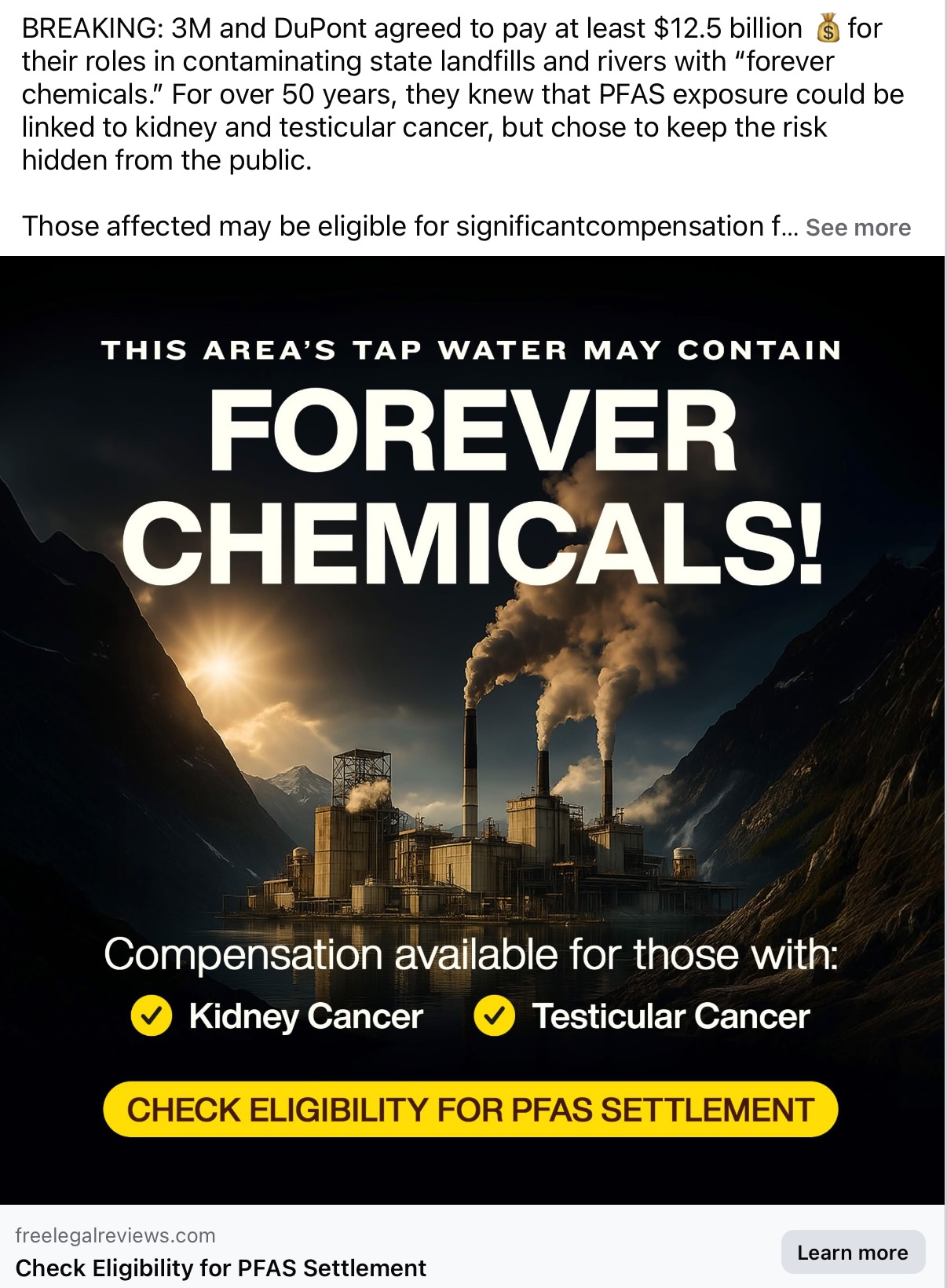
The term “Forever Chemicals” did not originate in a chemistry lab. It emerged from policy, legal, and advocacy circles as a way to convey urgency around a broad class of substances known as per- and polyfluoroalkyl substances (PFAS) (U.S. Department of Energy: https://www.energy.gov/pfas/pfas-and-polyfluoroalkyl-substances).
It is framed to be an empotionally powerful rhetoric, and intentionally so. The phrase was designed to quickly communicate to the public that certain PFAS:
• Do not readily break down in the environment
• Can accumulate over time
• Create long-term cleanup, regulatory, and liability challenges
This framing has been effective.
It helped move PFAS from a niche technical topic into the mainstream regulatory spotlight, accelerating monitoring, funding research, driving innovation in treatment technologies, and reshaping policy discussions at every level of government (DOE, link above).
However, while the phrase “forever chemicals” captures attention, it does not accurately reflect the chemical diversity or biochemical behavior of PFAS as a class.
PFAS are a Spectrum, not a Single Substance
PFAS are not one chemical. They represent thousands of distinct compounds with different molecular structures, properties, and behaviors. Chemical inventories such as the EPA’s DSSTox database identify well over 14,000 PFAS-related substances (summary reference: https://en.wikipedia.org/wiki/PFAS).
What PFAS share is the presence of multiple carbon–fluorine bonds, among the strongest bonds in organic chemistry. This structural feature gives many PFAS their exceptional stability, heat resistance, and chemical durability (U.S. Geological Survey, 2024: https://pubs.usgs.gov/of/2024/1001/ofr20241001.pdf).
That same durability is also why persistence has become the defining regulatory concern.
Persistence alone does not equal risk…
What “Environmental Persistence” Actually Means
In scientific terms, environmental persistence describes a substance’s resistance to degradation by biological, chemical, or physical processes under typical environmental conditions.
For PFAS, persistence generally refers to:
• Slow or negligible degradation in soil, sediment, and water
• Resistance to biological, chemical, and photolytic breakdown
• Long residence times once released into the environment
Many long-chain PFAS (most notably PFOA and PFOS) meet this definition and have been shown to persist globally in environmental and biological systems (U.S. EPA: https://www.epa.gov/sciencematters/understanding-pfas-environment). However, persistence exists on a spectrum, not as a binary condition. PFAS vary widely in how they behave once released.
Not All PFAS Behave the Same Way
Treating all PFAS as if they interact identically with ecosystems or human biology is scientifically inaccurate. Several distinctions matter:
Some PFAS are persistent and bioaccumulative
Certain PFAS, particularly long-chain perfluoroalkyl acids like PFOS and PFOA, resist degradation and accumulate in living organisms like humans. These compounds have human half-lives measured in years and have been associated with immune effects, developmental outcomes, and other health concerns (National Institute of Environmental Health Sciences: https://www.niehs.nih.gov/health/topics/agents/pfc).
Some PFAS transform rather than disappear
Many PFAS do not fully mineralize. Instead, they transform into other fluorinated compounds, extending persistence across chemical generations (Chemical & Engineering News, ACS: https://cen.acs.org/environment/persistent-pollutants/PFAS-environmental-persistence-own-enough/99/i14).
Fluoropolymers (such as PTFE) are persistent but not bioavailable
Large fluoropolymers such as PTFE (commonly known as Teflon®) are structurally and behaviorally distinct from small-molecule PFAS. These high-molecular-weight polymers are environmentally stable but not bioavailable, meaning they do not circulate in blood or bioaccumulate in tissues under normal conditions (ACS C&EN; Chemical Safety Facts: https://www.chemicalsafetyfacts.org/chemicals/pfas/).
This distinction is frequently lost in public discussion but is critical for informed policy and product evaluation.
Some PFAS are mobile rather than accumulative
Other PFAS may be rapidly excreted by organisms and instead remain highly mobile in water, presenting exposure concerns related more to transport and distribution than biological accumulation (U.S. EPA: https://www.epa.gov/sciencematters/understanding-pfas-environment).
Some polymers may never enter the body at all
Certain high-molecular-weight PFAS materials may pass through organisms unchanged—or never be absorbed—highlighting the importance of distinguishing environmental presence from biological relevance.
Language shapes Regulation, Risk, and Water Treatment
The phrase “forever chemicals” has played an important role in raising awareness. But as PFAS regulation matures, precision must matter more than rhetoric.
In 2024, the U.S. EPA finalized the first national drinking water standards for several PFAS compounds, setting enforceable maximum contaminant levels based on compound-specific health data (Associated Press summary: https://apnews.com/article/517ce0049ffbd2931157da4970992f05). Regulations have changes since then and the latest EPA ruling strives to be a balance between cost and protection. (EPA press release: https://www.epa.gov/newsreleases/epa-announces-it-will-keep-maximum-contaminant-levels-pfoa-pfos)
This regulatory approach reflects an essential reality: Risk depends on chemistry, exposure pathway, dose, and duration. Persistence alone does not equal harm, and lack of degradation does not imply uniform toxicity or mobility.
Overly broad language can result in:
• Misaligned regulations
• Unintended liability exposure
• Public confusion between real and theoretical risks
• Erosion of trust in regulators, utilities, and water professionals
A better path forward for PFAS policy and water practice
Effective PFAS policy, and responsible product communication, must be:
• Chemistry-specific, recognizing meaningful differences among PFAS
• Exposure-based, grounded in realistic pathways and doses
• Outcome-focused, prioritizing measurable health and environmental benefits
For those of us working in water treatment, regulation, and public health, precision is not theoretical, it directly affects infrastructure decisions, treatment performance, and public trust.
The phrase “forever chemicals” succeeded in raising awareness. But the future of PFAS management belongs to science-driven nuance, not oversimplification.
What a great time to be in the water business!
Additional Reading
U.S. Department of Energy – PFAS Overview
https://www.energy.gov/pfas/pfas-and-polyfluoroalkyl-substances
U.S. Environmental Protection Agency – Understanding PFAS in the Environment
https://www.epa.gov/sciencematters/understanding-pfas-environment
U.S. Geological Survey – PFAS Environmental Behavior (2024)
https://pubs.usgs.gov/of/2024/1001/ofr20241001.pdf
Chemical & Engineering News (ACS) – PFAS Persistence and Polymer Distinctions
https://cen.acs.org/environment/persistent-pollutants/PFAS-environmental-persistence-own-enough/99/i14
National Institute of Environmental Health Sciences – Health Effects of PFAS
https://www.niehs.nih.gov/health/topics/agents/pfc